
Titus County Sex Offender Checks
The Texas Public Sex Offender Registry is the primary public channel for Titus County. Texas DPS builds it from data sent by local registration authorities. A county filter gives a broad local view, while a name or address can narrow the result set. Search Mount Pleasant, Winfield, and Talco separately when city context matters. The registry is free to search and does not require a paid people-finder service.
No separate Titus County registry portal or sheriff map was documented in the official research. That makes the DPS registry the sound starting point, not an unofficial list. The federal NSOPW search adds cross-state coverage. Local law enforcement supplies the public subset it holds and handles local registration questions, but the state portal offers the most direct countywide search.
Titus County Registry Authority Contacts
A person who must register reports through the designated local law-enforcement authority. For Titus County, the Sheriff's Office is the county starting point at 304 South Van Buren Avenue, Mount Pleasant, TX 75455, telephone 903-572-6641. City residents should call first to confirm whether the sheriff or Mount Pleasant Police Department is their designated authority and to obtain current appointment and verification instructions. A local authority must release the public subset and may charge a reasonable administrative cost. The research does not publish a registry-desk schedule, so do not assume walk-in hours.
Titus County Sheriff's Office
Registration authority starting point
304 S. Van Buren Ave.
Mount Pleasant, TX 75455
903-572-6641
Call for current instructions
The official Winfield City Hall page provides a local contact route where no dedicated city police-records or registry portal is published.

Winfield residents can use City Hall to identify the correct local office, then confirm registration or record details with the designated law-enforcement authority.
Texas Public Sex Offender Registry Searches
Texas DPS manages the registry search and modernized its public interface in 2024. Labels can shift as the interface changes, but the documented paths remain name, location, county, city or ZIP, and map searches. A countywide query is useful for broad awareness. An address-based search is better for a defined area. Name searches require care with aliases and similar names.
- Open the official Texas registry and review its conditions and safety notices.
- Choose a name search or enter Titus County, a local city or ZIP code, or a street address.
- Review the list and map, then compare the displayed name, aliases, physical details, and registering agency.
- Open the full profile and read the offense, status, risk level, reported address, and registration details together.
The official Texas DPS registry interface shows the live controls used for Titus County searches.
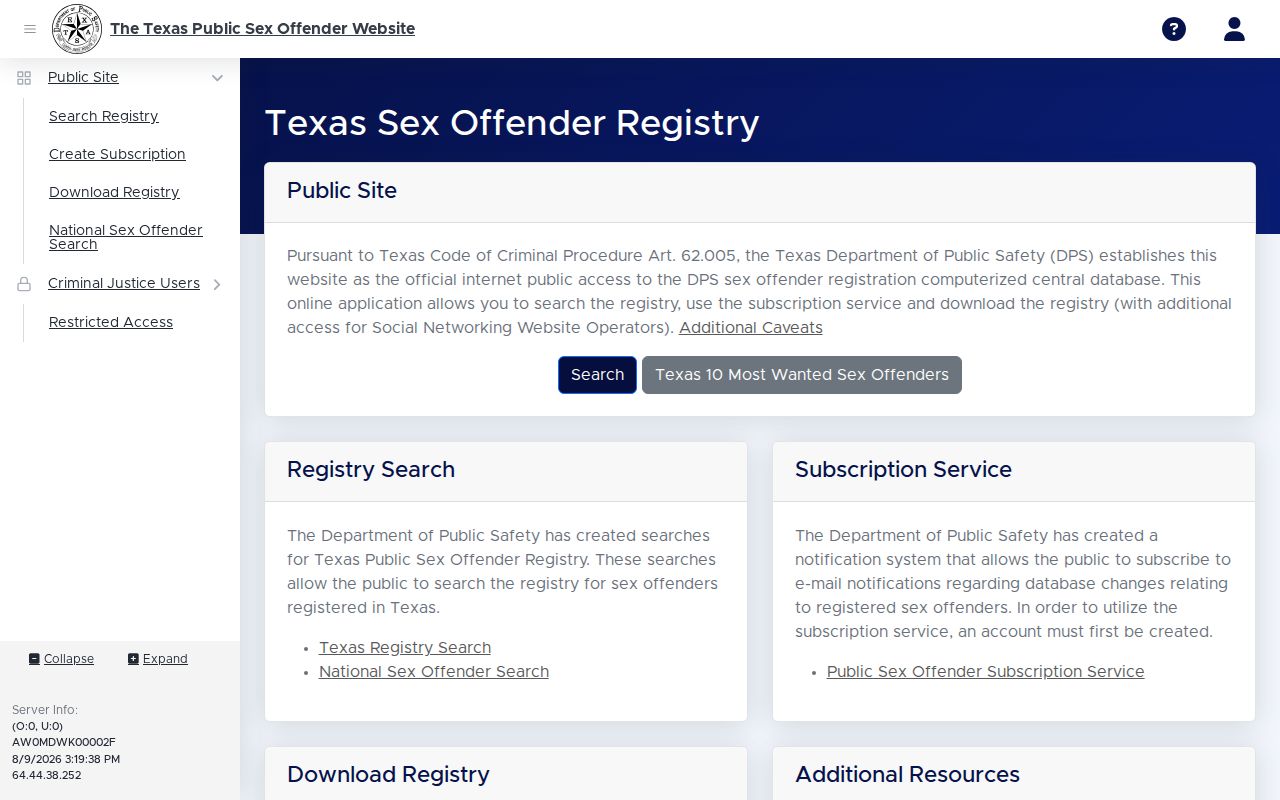
This state search should be preferred over copied lists because the responsible Texas agencies supply and update the registry data.
| Field or Control | Type | Required | Options and Notes |
|---|---|---|---|
| Search by Name | Tab / form | Varies | First and last name with available variants |
| Location / Address | Tab / form | Address basis | Street, city, state, and ZIP; may return proximity results |
| County | Dropdown / text | For county search | Select Titus for countywide results |
| ZIP / City | Text | When used | Mount Pleasant, Talco, Winfield, or a ZIP code |
| Map Search | Map control | Location basis | Shows proximity, not whether an address violates a rule |
| Submit / Search | Button | Not applicable | Runs the selected query |
| Clear / Reset | Button | Not applicable | Removes the current criteria |
Titus County Registry and NSOPW
The Texas registry is the best source for a Titus County-only review. The Dru Sjodin National Sex Offender Public Website, known as NSOPW, searches participating jurisdiction data across state lines. It helps when a person may have moved or when a safety check spans more than Texas. NSOPW does not create a new federal profile. It points back to information supplied by the responsible jurisdictions.
The official NSOPW search view shows the national layer used alongside a Titus County registry query.
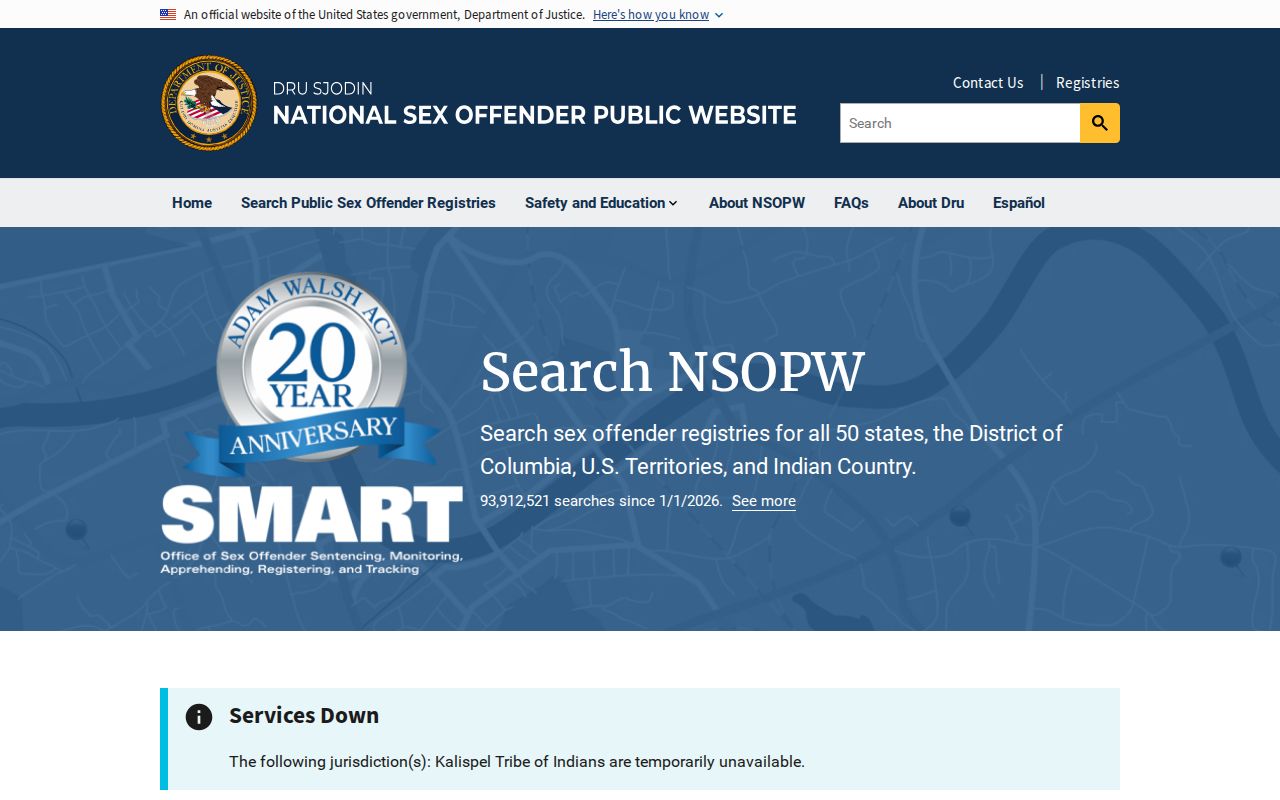
If the national and Texas displays differ, contact the registering agency shown on the profile. NSOPW warns that jurisdiction data can change, so the office responsible for the record should resolve a discrepancy.
Note: A Titus County no-result does not rule out a record reported by another participating jurisdiction outside Texas.
Registry Profiles: What They Show
A public Titus County registry profile is an offense-specific registration record, not a complete criminal-history report. It can identify the registrant, the reported residence, the registering agency, and the reportable offense. Readers should compare several fields before deciding that a profile belongs to the person they had in mind. The offense date, conviction or adjudication jurisdiction, and status give needed context beyond a photograph or pin.
| Name & Aliases | Registered name and reported alternate names |
|---|---|
| Photo & Description | Photograph, sex, race, height, weight, eye and hair color, and marks or tattoos where displayed |
| Identity Key | Birth date or age as shown and the Texas DPS state identification number |
| Reported Location | Residence or address and map, registering agency, and allowed school or vehicle fields |
| Offense Record | Offense and statute, conviction or adjudication date, jurisdiction, and public victim age or sex category without identity |
| Registry Status | Risk level, registration status, and release or disposition details when supplied |
Texas Code of Criminal Procedure Article 62.005 excludes Social Security and driver's-license numbers, phone numbers, victim-identifying details, and specified protected data. Employer contact details and a registrant's phone number are not public profile fields. Their absence is a legal privacy boundary, not an incomplete search screen.
Titus County Registry Map Limits
A map marker shows the location reported in the public registry. It does not decide whether the address violates a school-zone, park, or other residency rule. Texas registration duties arise from Chapter 62, but the research does not establish one blanket Titus County distance rule that can be applied to every pin. Court orders, parole conditions, local rules, offense facts, and the registrant's legal status can differ.
Use the map for proximity and safety planning. Read the profile status and registering agency, then ask the proper authority about a suspected compliance issue. Do not confront a person at the mapped address. The address may also change between verification and public display, which is why correction and reporting channels matter.
Registration Levels and Duties in Texas
Texas uses risk assessments labeled Low (1), Moderate (2), and High (3). Those labels describe assessed danger and notification use. They do not set the registration term by themselves, and they should not be converted into the federal Tier I, II, and III scheme. The offense and Chapter 62 control whether the duty generally lasts ten years or life.
| Texas Designation | Meaning or Use | Registration Duration |
|---|---|---|
| Low (1) | Assessment suggests low danger; public when Chapter 62 makes the record public | Set by the offense, not the risk label alone |
| Moderate (2) | Intermediate assessed danger | Offense-based statutory period |
| High (3) | Serious danger; enhanced community-notice provisions apply | Offense-based statutory period |
| Civil commitment notation | A separate statutory process where applicable | Underlying registration rules still control |
Article 62.101 generally requires lifetime registration for listed sexually violent and other enumerated offenses. Other reportable convictions or adjudications generally end on the tenth anniversary of release from a penal institution or discharge from community supervision, whichever comes later. Juvenile, federal, early-termination, multiple-offense, and other special rules can change that result. Verify the exact offense rather than guessing from the risk number.
Titus County Level Three Registry Notices
For a high-risk Level Three registrant, Chapter 62 provides a local notice framework that fits both the rural and subdivided parts of Titus County. The stated mailed or delivered notice area is a one-mile radius in an unsubdivided area or a three-block area in a subdivided area. Notice is provided in English and Spanish, and local authorities may use other permitted notice methods.
The official history of Winfield's municipal building documents one of the small-city public contact points within Titus County.

The building image provides local civic context, not a registrant location. Winfield residents should confirm the designated registration authority and current notice process rather than infer duties from city limits or a map pin.
Using Registry Information Lawfully
Registry access serves personal and family safety and community awareness. It does not authorize a reader to threaten, follow, expose, or punish anyone. Texas Code of Criminal Procedure Chapter 62 defines the public information and notification system. Article 62.009 limits release to public information, and Article 62.005 identifies fields that must remain out of the central public database.
Misuse can be a crime. Texas Code of Criminal Procedure Chapter 62 does not authorize harassment, threats, trespass, discrimination, or vigilantism. Such acts may violate criminal or civil law.
Community notice is an official process, not an invitation for private enforcement. Call 911 for an emergency. For a non-emergency concern, give the responsible agency the profile, location, date, and reason the entry appears wrong or out of date. Avoid reposting protected details or adding claims that do not appear in an official record.
Correcting Titus County Registry Data
If a Titus County entry looks old, use the registry's report or correction function or contact the registering agency shown on the profile. Describe the exact field, save the public record URL or profile identifier, and state what appears inconsistent. Local law enforcement can check its source record and route updates to Texas DPS. An apparent error does not justify confronting the person or household.
For a registration question, start with the Titus County Sheriff's Office at 903-572-6641. City residents should confirm whether Mount Pleasant Police or the sheriff is the designated authority. NSOPW discrepancies go back to the jurisdiction that supplied the data. These channels serve different roles: DPS publishes the Texas database, the local authority reports and verifies local facts, and NSOPW displays jurisdiction-fed records across borders.